7 E. Silver Springs Blvd., Suite 300, Ocala, FL 34470

To strengthen a personal injury case, you need objective proof that establishes who is at fault for the accident and validates the physical, emotional, and financial toll it had on you. Below is the evidence needed for an injury claim.
Evidence For Accident Injury Claims
After an accident, unfortunately, your word alone is not enough to build a strong injury claim. Any gap or inconsistency in your story can also give the defense room to minimize your payout, or deny responsibility for the accident altogether. The stronger documentation you have, the harder it becomes for the other side to question what happened or how seriously you were hurt.
The most important evidence in a personal injury case usually includes medical documents, visual evidence (like photos and video), and financial documentation. Below, we break down how we organize and examine this evidence to maximize your potential recovery.
The Burden of Proof in Personal Injury Claims
In personal injury law, the burden of proof falls on the injured party, also called the plaintiff. This means it is entirely their responsibility to prove that the other party acted negligently or carelessly and directly caused their injuries. While the law places this burden on the plaintiff, a personal injury attorney’s job is to carry that weight for you.
Types of Personal Injury Claims & Accidents
Personal injury law covers a range of accidents. While the core requirement (proving negligence) remains the same across the board, your individual circumstances will dictate the type of claim filed and the evidence needed. Below are common types of personal injury cases.
| Type of Claim | Common Examples |
|---|---|
| Motor Vehicle Accidents | Car crashes, truck collisions, motorcycle wrecks, and pedestrian accidents |
| Premises Liability | Slip and falls, dog bites, inadequate security, and swimming pool accidents |
| Product Liability | Defective car parts, dangerous pharmaceuticals, and faulty consumer goods |
| Workplace Injuries | Construction accidents, industrial exposure, and equipment failures |
| Wrongful Death | Fatal accidents caused by negligence, medical malpractice, or intentional harm where surviving family members seek compensation on behalf of the deceased |
Evidence by Accident Type
Different types of accidents will require specific kinds of evidence to establish negligence. For instance, here is a breakdown of what strengthens cases involving different motor vehicles.
| Accident Type | Key Evidence to Collect & Preserve |
|---|---|
| If You’ve Been In a Car Accident |
|
| If You’ve Been in a Truck Accident |
|
| If You’ve Been in a Motorcycle Accident |
|
Because key evidence can be lost, repaired, deleted, or forgotten, it is important to start documenting as soon as possible after the accident.
Not sure what to do after a motorcycle accident? Start here with guidance on scene documentation, insurance requirements, and protecting your rights.
Collecting Evidence at The Scene of an Accident
It is completely understandable to want a legal professional to handle every aspect of your case, especially since the aftermath of an accident is chaotic and overwhelming.
However, the reality is that a lawyer cannot physically be at the scene in the minutes immediately following an accident. At that moment, you (or a capable passenger) are the “first responder” for your own injury claim.

Here is a breakdown of what you must do yourself versus what a lawyer will do for you later.
1. Collecting Proof at the Scene (Photos/Videos)
- What you must do: Take the initial photos and videos of the vehicles, skid marks, and weather conditions before the cars are towed and the debris is swept away.
- What a lawyer does later: Once hired, a lawyer can send an investigative team to the crash site to take professional measurements, track down nearby security or traffic cameras that might have captured the crash, and inspect the damaged vehicles at the tow yard.
2. Collecting Witness Information
- What you must do: Bystanders usually leave as soon as the police or paramedics arrive. You want to grab their names and phone numbers before they drive away.
- What a lawyer does later: A lawyer’s team will take the contact information you gathered, reach out to those witnesses, conduct formal interviews, and obtain sworn statements or depositions to build your case.
3. Filing a Police Report
- What you must do: You must call 911 (or the local non-emergency police line) to get law enforcement to the scene so they can document the incident.
- What a lawyer does later: Your attorney will officially request the final, filed police report from the precinct, review the officer’s diagrams and fault assessments, and use that document as a baseline to fight the insurance companies.
Florida residents can use the Florida Crash Portal to officially request and purchase their traffic crash report. Note that reports may take up to 10 days to become available.
As Soon As You Leave The Scene of The Accident
As soon as you leave the scene and make it to a safe place (or the hospital), you can hire a lawyer. From that point forward, they will handle the heavy lifting of gathering, preserving, and arguing the evidence.
Proving Invisible Injuries
What Is The Most Difficult Injury To Prove?
When an accident results in a broken bone or a deep cut, an X-ray or a photograph provides immediate, indisputable proof of the harm. The most difficult injuries to prove are “invisible” injuries. Because they cannot be easily quantified or seen on a standard diagnostic scan, insurance companies will often dispute their severity or deny that they exist at all.
The most challenging injuries to prove include:
- Soft Tissue Injuries: Sprains, strains, and whiplash often do not show up on standard X-rays. Insurers notoriously downplay these injuries, claiming they are exaggerated or pre-existing.
- Traumatic Brain Injuries (TBIs): While severe brain bleeds are visible on MRIs, mild-to-moderate concussions often leave no structural evidence. Symptoms like memory loss, mood swings, and chronic headaches are subjective and require specialized neurological testing to validate.
- Emotional Trauma and PTSD: The psychological toll of an accident (such as anxiety, depression, or a phobia of driving) is entirely internal. Proving mental anguish requires comprehensive documentation from mental health professionals.
How to Validate Invisible Injuries
If you are suffering from an injury that lacks straightforward visual proof, you must rely on a consistent, detailed paper trail to protect your claim.
- Seek Immediate and Continuous Medical Care: A doctor’s official notes detailing your reported symptoms, reduced range of motion, and treatment plans provide objective medical backing to your subjective pain.
- Keep a Daily Pain Diary: Documenting your daily pain levels, sleep interruptions, and the ways the injury prevents you from performing routine tasks establishes a credible timeline of your suffering.
- Rely on Expert Testimony: Your legal team can hire neurologists, orthopedic specialists, or psychiatrists to explain exactly how these complex injuries impact your life and why they are just as severe as visible wounds.
- Gather Impact Statements: Written accounts from friends, family, and co-workers detailing the changes in your physical abilities and personality before and after the accident can serve as powerful, corroborating evidence.
Should I Keep a Pain Diary?
Yes. A pain diary is one of the most effective ways to substantiate injuries and emotional distress over time. It is also one of the most persuasive and underutilized tools in personal injury litigation. Written in your own voice and updated regularly, it becomes concurrent evidence that is very difficult for defense attorneys to challenge.
What To Include In a Pain Diary
- Document your pain levels: Rate your pain on a scale of 1-10 throughout different times of the day.
- Document interruptions to sleep or mobility: Note nights you wake up in pain or days you struggle to walk or lift objects.
- Document emotional stress and anxiety: Record feelings of depression, PTSD symptoms, or fear of driving.
- Document any missed activities: Log if you’ve missed regular activities, family events, or obligations such as work due to your injuries.
Personal Injury Impact Statements
Beyond medical records, courts and insurance adjusters want to understand how your injuries have disrupted your life. An impact statement is a written document that details exactly how the accident has affected your day-to-day.
This gives you the opportunity to put your suffering into your own words, describing changes like what you could do before the accident and what you can no longer do, how relationships have changed, and the emotional weight of your ongoing recovery.
What Medical Records Do I Need For A Personal Injury Case?
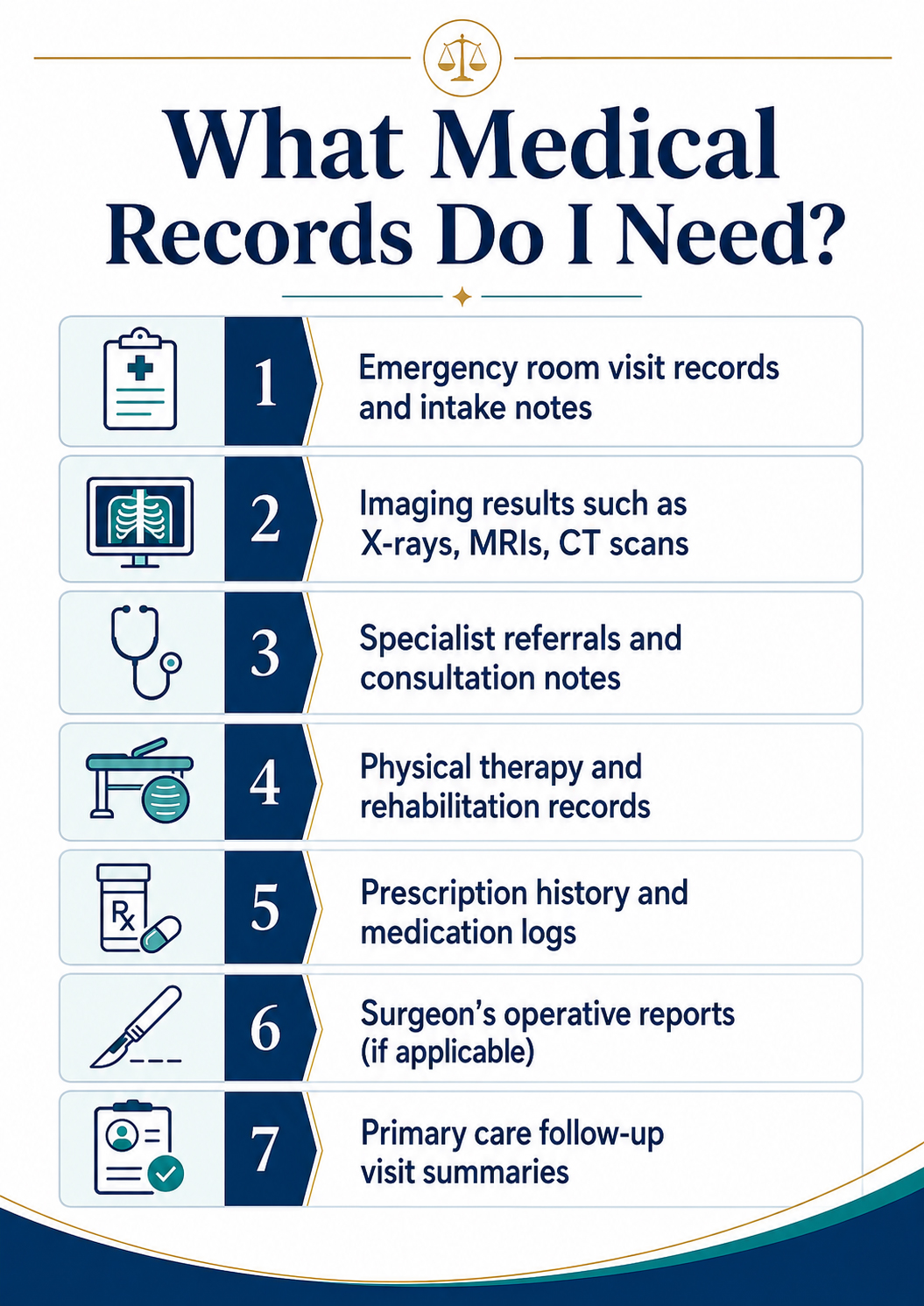
Medical records are the foundation of your injury claim. Must-have documents include records such as ER admission charts, diagnostic imaging (X-rays, MRIs), surgical notes, physical therapy logs, and pharmacy receipts. The records you gather should tell a clear, uninterrupted story from the moment of injury through your ongoing recovery.
Important Tip: Avoid gaps in medical care, and try to attend every scheduled appointment for follow-up care. Insurance companies will use missed appointments to argue that you aren’t as injured as you claim.
Documenting Your Total Losses
Beyond physical pain, an accident impacts your finances. To recover maximum compensation, you must document your financial burden entirely. Keep a dedicated file of:
- All medical bills and copays.
- Pay stubs and employer letters proving lost wages.
- Estimates for future medical care.
- Receipts for out-of-pocket expenses (like medical equipment, rental cars, or hiring help for household chores).
Conducting a Formal Discovery
Once a lawsuit is filed, your attorney gains access to a powerful set of legal tools through the formal discovery process. Unlike evidence gathered at the scene, discovery compels the opposing party to disclose information they may be reluctant to share voluntarily.
Discovery tools your attorney may use:
- Interrogatories: Written questions the opposing party must answer under oath.
- Depositions: Sworn in-person testimony from the defendant, witnesses, or expert witnesses.
- Requests for production: Compels the opposing party to hand over documents, records, and communications.
- Requests for admission: Asks the opposing party to admit or deny specific facts, narrowing what’s in dispute
This discovery may include documentation such as internal safety reports, prior complaints against the other party, or even communications that contradict their version of events.
Record Requests and Private Investigators
We leave no stone unturned. Our attorneys will work to secure surveillance footage of your accident by issuing preservation letters to nearby businesses, and filing public records requests for traffic and government cameras.
We also work with private investigators to locate hard-to-find witnesses, preserve perishable evidence, and thoroughly document the long-term impact of your injuries.
How Hightower & Hightower Attorneys Protect Your Rights
While you focus on healing, Hightower & Hightower’s personal injury attorneys will handle the heavy lifting of gathering, preserving, and arguing the evidence required to maximize your recovery.
You shouldn’t have to fight insurance corporations or navigate legal discovery alone, especially while trying to recover. Let our experienced Florida personal injury team handle your case from start to finish.
Call Hightower & Hightower today or fill out our online form to schedule your free, no-obligation case consultation.