
It’s a good idea to consider hiring a workers’ comp lawyer if you’re dealing with a denied claim, delayed or stopped benefits, or issues with your doctor or treatment. The same goes if your injury is serious or permanent, or if you’re being offered a settlement from the insurance company.
On the other hand, if your injury is minor and you’re back to work quickly, with all of your bills paid and checks coming in on time, you might not need a lawyer. At Hightower & Hightower P.A., you can get a free consultation about your case. Getting an expert opinion from our workers’ compensation attorneys won’t cost you anything.
Keep reading for when it’s time to call a lawyer, the situations where you may not need one, what a workers’ comp attorney costs in Florida, and the deadlines you can’t afford to miss.
When you report an injury to your employer, their insurance company usually steps in quickly. They choose a doctor for you to see, figure out if they’ll cover your medical expenses and lost pay, and they might request some paperwork or a recorded statement from you. (Before you give a recorded statement, it’s best to talk with a workers’ comp attorney first.) For the most part, this process moves forward smoothly, but sometimes not.
If your benefits are suddenly cut off, your treatment is denied, or the insurance company claims that your injury isn’t related to your job, that’s when having a lawyer on your side can make a big difference in your case. To know what to do right away after getting hurt at work, check out our guide on the immediate steps to take after a workplace injury.
If you’re wondering how the whole workers’ compensation process works in Florida, we’ve got that covered too. Just take a look at our overview of Workers’ Compensation in Florida.
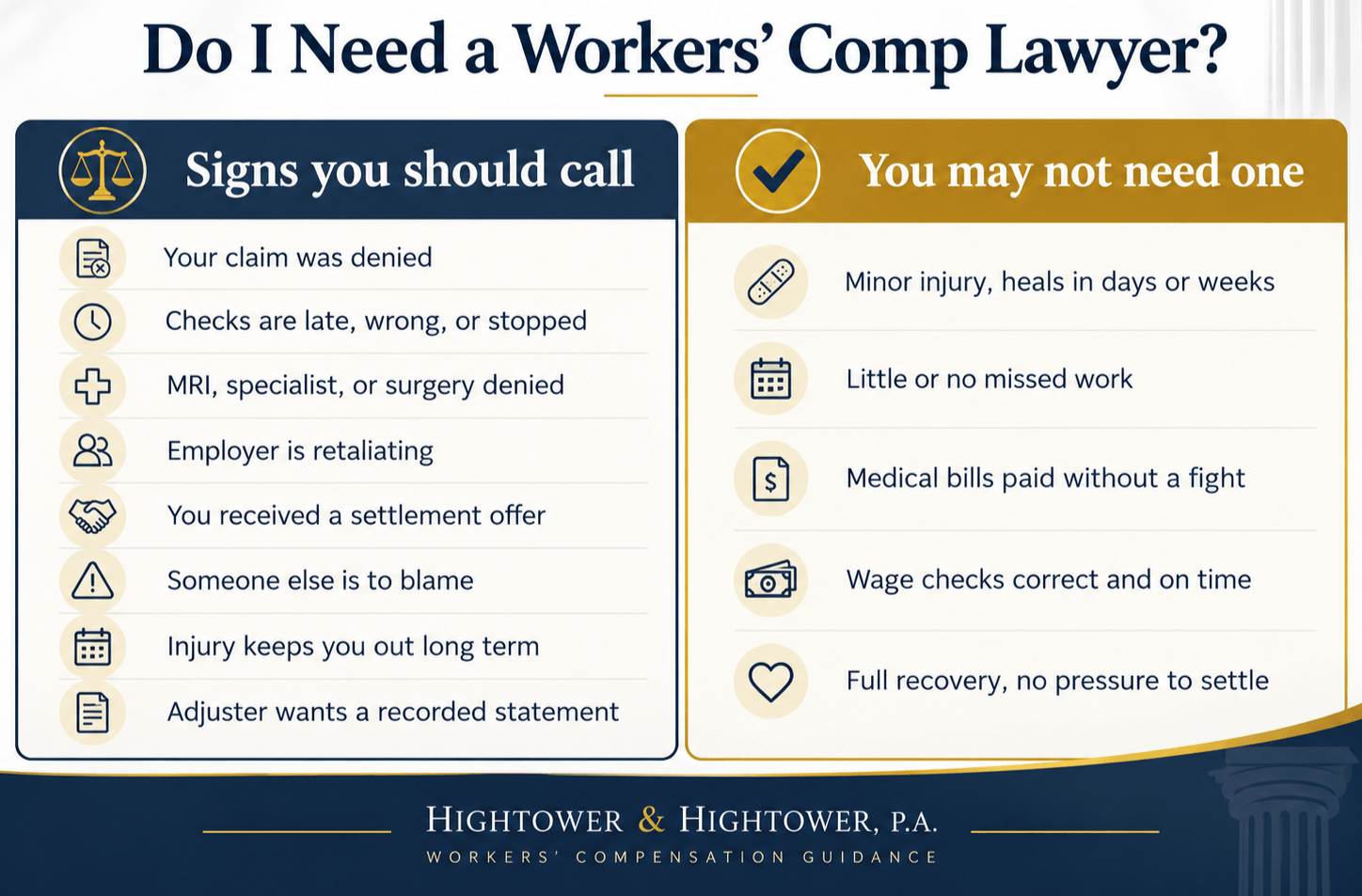
Call an Ocala workers’ compensation attorney if:
Your claim was denied. The carrier says it is not work related, was preexisting, was not reported in time, or the statute of limitations has run.
Your checks are late, wrong, or stopped. Temporary benefits should arrive on a schedule. Average weekly wage mistakes are also common.
Your MRI, specialist, or surgery was denied. Denied treatment still hinders your recovery, even if the claim itself was accepted.
You don’t get to pick your own doctor. Instead, the insurance company decides which doctor you can see. You can ask to switch doctors one time if you put your request in writing.
You’re being forced back into work. Going back to work too quickly can also make your injury worse and even hurt your chances of getting the help you need.
Your employer is retaliating. Firing, cutting hours, or threatening you after you report an injury is illegal.
You received a settlement offer. Settlements can close out future medical care, so get a workers’ comp lawyer to review before you sign.
Your injury will keep you from working long term. Permanent impairment or a possible Social Security disability claim raises the stakes.
The adjuster wants a recorded statement. Talk to a lawyer before you agree to one.
“I was in an accident and Hightower & Hightower was recommended as a local family run practice with an excellent reputation. I'm very glad I followed the recommendation. Mr. Hightower gave me a thorough run down of the process and I felt confident in my decision right off the bat.” — Jorge G., Hightower & Hightower client
Not every work injury needs an attorney. You may be fine handling the claim yourself if:
The injury is not too serious and gets better on its own in a short time, usually within a few days or weeks.
You missed little or no time from work.
Your medical bills are being paid.
Your wage checks are correct and on time.
Not sure if you need a lawyer? Contact our team at Hightower and Hightower, P.A. to find out.
Jump to the section that matches what’s happening with your claim, to learn your options and when it may be time to call a workers’ comp attorney.
Don’t think that a denial is the final word. Insurance companies will try to get out of paying by claiming the injury didn’t happen on the job, that it was a pre-existing condition, or that it was never reported properly. That’s where a lawyer can help you. They collect all the necessary medical records, statements from coworkers, and documents from your employer, and then file a Petition for Benefits if needed. The key for you is to act quickly and reach out to a lawyer, because delaying only means you’re losing time and risking missing important deadlines.
Sometimes the workers’ compensation claim is accepted, but the insurance carrier refuses an MRI, referral, or a needed surgery. An attorney can push for authorization and, if necessary, take the dispute to a judge. Keep every denial letter you receive.
If you’re getting temporary wage benefits in Florida, you can expect to get about two-thirds of your average weekly pay, which is usually paid every other week. But here’s the thing: there’s a waiting period for the first seven days, unless you’re out of work for a long time.
If the amount you’re getting seems too low, it’s possible that the insurance company made a mistake with the numbers or forgot to include your overtime pay. If your checks also stop coming before you’re feeling better, you might want to get a lawyer to double-check the math and make sure everything is correct.
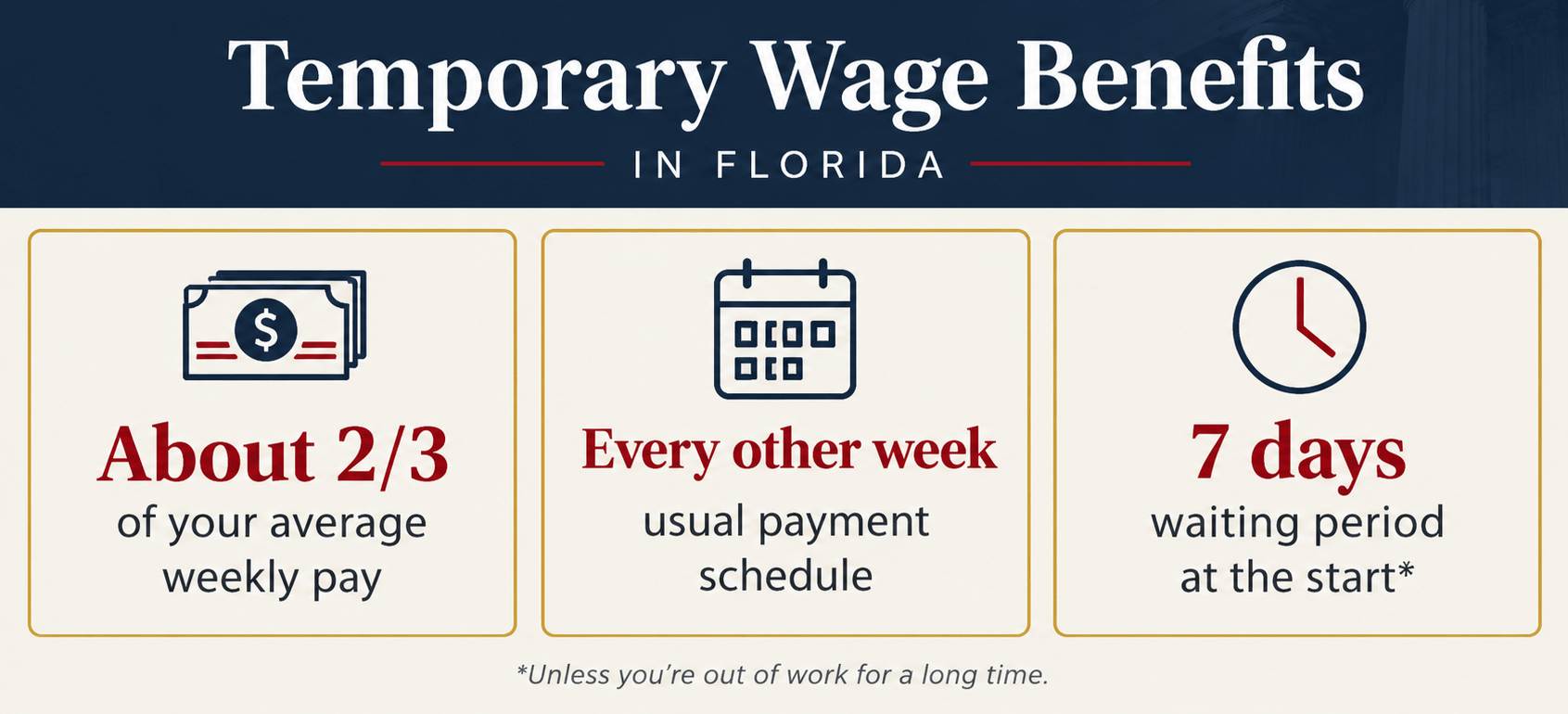
Temporary wage benefits at a glance.
When it comes to workers’ comp settlements in Florida, it’s important to remember that they’re entirely voluntary. No one can force you to settle, and you don’t have to accept the first offer. If you do settle, you usually get a lump sum in exchange for closing out some or all of your benefits.
If that includes your medical benefits, the insurance company stops paying for treatment related to that injury. Any future doctor visits, surgery, or medication for it would then come out of your pocket, which is why it’s important to know what your future care could cost before you sign.
Don’t let an overly friendly insurance adjuster or a sizable check convince you to sign on the dotted line without very careful consideration. We recommend you have a professional like our workers’ comp lawyers, Barbara L. Richard, or Mark N. Tipton, review the terms of the settlement. This will ensure you understand if you’re giving up any benefits, and it could make a big difference in the long run.
If you’re fired for filing a workers’ comp claim in Florida, that’s against the law. That said, retaliation can be sneaky. It might look like your hours get cut down, you get demoted, or you’re pressured to quit your job. So, make sure to keep track of everything: write down important dates, save emails, and get witness statements. If you believe your employer is retaliating, we’re here to talk you through the situation.
If you get hurt on the job, workers’ comp is usually the only way to get money from your employer for the injury. But, if someone else was responsible for the accident, you might also be able to file a personal injury claim, which is a separate claim from workers’ comp.
If you’re unable to go back to your old job, you might need to look into impairment benefits, permanent total disability, reemployment assistance, or Social Security Disability.
These options can be connected, and the timing of when you apply for them is important. A lawyer who specializes in workers’ compensation can help you get the right medical proof so that one claim doesn’t interfere with another, and they can coordinate everything to make sure you get the help you need.
You don’t have to pay anything upfront to hire a workers’ compensation attorney at Hightower & Hightower, and your first consultation is free.
In Florida, the cost of hiring a lawyer for workers’ compensation cases is controlled by law and needs to be okayed by a judge. Usually, the lawyer’s fee is based on the benefits they help you get, and the judge has to give approval before anyone gets paid. You shouldn’t have to pay out of pocket just to figure out where you stand with your case.
Florida is strict about timing. Missing a deadline can end a good claim.
30 days is the time limit to inform your employer about the injury. You should report it within 30 days of getting hurt, or within 30 days of when your doctor says it’s related to your job. Try to report it as soon as you can.
2 years is the time limit to file a Petition for Benefits. Generally, you need to file within 2 years from when you realized or should have realized that your injury was related to your job (F.S. § 440.19).
1 year from your last check or treatment. Each time you receive a benefit check or authorized medical care, you get one more year from that date to file a Petition for Benefits, even if the 2-year deadline has already passed. However, this extension doesn’t apply to every issue, like whether your injury is covered or how much permanent impairment you have, so don’t assume you have more time than you actually do.
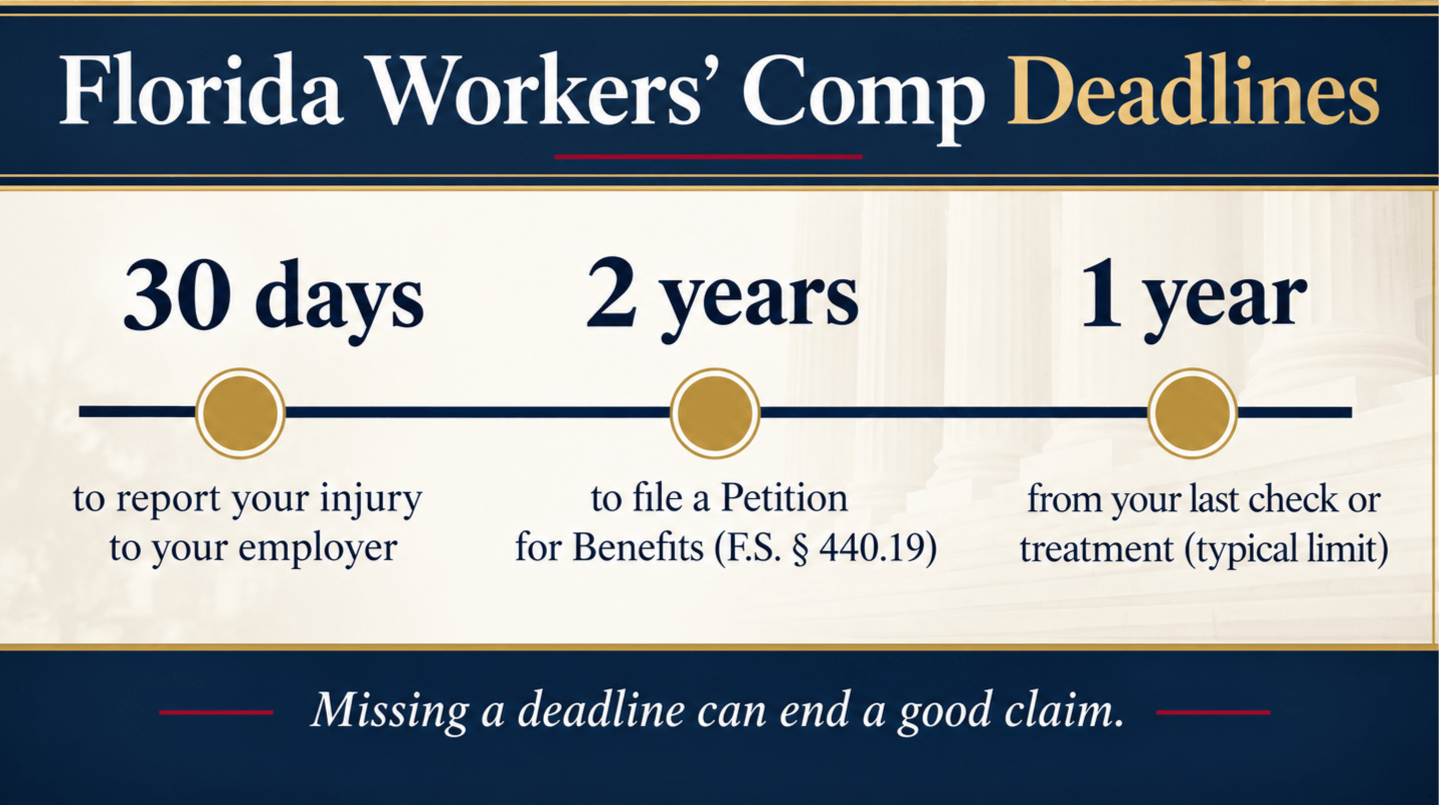
Florida workers’ comp deadlines at a glance.
If you know that your deadline is approaching, give us a call and we’d be happy to set up a consultation to discuss your case.
What NOT to Do After a Work Injury
Don’t wait too long to report. If you wait more than 30 days, you might not be able to file your petition.
Do not skip authorized doctor appointments. Gaps give the carrier a reason to argue you healed or the injury was never serious.
Don’t say anything on record before you’ve had a chance to talk to a lawyer. Anything you say can be used against you later on, which might limit or even deny you benefits.
Do not sign a settlement or release without review. Don’t sign anything until you understand what future medical care and wage benefits you are giving up.
Do not post about your injury, activities, or pain on social media. Investigators watch. One photo can be twisted against you.
Do not assume “light duty” means the work is safe for you. If your doctor clears you for light duty, your employer may offer work that fits your restrictions, like no lifting over 20 pounds or limited standing. If the tasks you’re given go beyond those limits, tell your employer in writing and let your authorized doctor know at your next visit.
What a Board-Certified Workers’ Comp Lawyer Does
Florida Bar board certification in workers’ compensation is a voluntary, rigorous credential. It signals focused experience in this area of law, not just a general practice that takes the occasional work injury.
At Hightower & Hightower, attorneys Barbara L. Richard and Mark N. Tipton are experts in workers’ compensation, and they’re here to help. They’ll take care of dealing with the insurance adjuster, make sure you get the right amount of weekly benefits, and fight for the medical treatment you need if it’s been denied.
If the insurance company is giving you trouble, they’ll even file a Petition for Benefits on your behalf. For over 45 years, our law firm has been helping injured workers in Ocala, Bell, and all across Marion County and North Central Florida get the support they deserve.
Frequently Asked Questions
In Florida, it’s actually illegal for your employer to fire you just because you filed a workers’ compensation claim. However, this doesn’t mean they have to keep your exact job open indefinitely. If you think you were let go or forced out after reporting an injury, you should talk to a lawyer about possible retaliation and how it affects your benefits. They can help you figure out what’s going on and what you can do about it.
When you’re injured on the job, your employer’s insurance company typically gets to pick the doctor you see. However, you do have some say: you can ask to switch doctors once, and you need to put your request in writing. The insurance company then has a limited time to choose a new doctor for you. Just remember, if you decide to see a different doctor without going through the proper channels, you might end up with a big bill that the insurance company won’t cover.
If you can’t work because of an injury that workers’ comp has accepted as work related, you may be eligible for temporary wage benefits, usually about two-thirds of what you normally earn in a week. In Florida, there’s a waiting period for the first seven days, but if your injury keeps you out of work for a longer period, you might still get benefits. These temporary benefits don’t last forever, though. There’s a limit on how long you can receive them. For more information on the different types of benefits, you can check out the details on Workers’ Compensation in Florida.
Before you give any statements, it’s a good idea to talk to a workers’ comp lawyer. They can help you figure out what to say and what not to say. You should also cooperate with requests for information, but don’t feel like you have to talk to anyone without being prepared. Let your lawyer handle any follow-up calls with the insurance company. That way, nothing you say can be taken out of context or used to deny, reduce, or delay your benefits.
You can get both, but there’s a cap on how much they can add up to when combined. Under federal rules, your workers’ comp and Social Security disability benefits together generally can’t be more than 80% of what you earned before your injury. In Florida, if the combined amount goes over that limit, your workers’ comp payment is usually the one that gets reduced.
No. Many people call after a denial, a stopped check, or once they’ve received a settlement offer. Bring your paperwork to your consultation. An attorney can still review your deadlines, correct wage calculations, and fight for any unpaid benefits you’re owed.
The Florida Bar’s board certification in workers’ compensation is one of the best signs to look for, because it takes years of focused experience and a rigorous exam. Read reviews, ask how long they’ve been handling workers’ comp cases in your area, and take advantage of a free consultation to see if they’re a good fit. At Hightower & Hightower, Barbara L. Richard and Mark N. Tipton are both board certified in workers’ compensation.
The Florida Division of Workers’ Compensation, part of the Department of Financial Services, posts the official forms and publications on its website. Forms for disputes, like the Petition for Benefits, are available through the Office of the Judges of Compensation Claims. The division’s Employee Assistance Office can also help you at 800-342-1741. Remember that an attorney can file the right forms for you, so you don’t have to sort through them alone.
Report your injury to your employer as soon as possible, and within 30 days. Your employer then reports it to their insurance company, which reviews the claim and sends you to an authorized doctor. If the claim is denied or benefits stop, you can file a Petition for Benefits to have a judge resolve the dispute. For a full walkthrough, see our guide on what to do immediately after a workplace injury.
If you’ve been hurt on the job and are unsure about your next steps, consider reaching out to Hightower & Hightower for guidance. You can call at 352-629-7777 to schedule a free consultation.
With offices in Ocala and Bell, and two board-certified workers’ compensation attorneys on staff, we have the expertise to help you navigate the process. Hightower & Hightower has been supporting injured workers since 1976, and we’re available to assist you in either English or Spanish (Hablamos Español).
Our main office is located at 7 E. Silver Springs Blvd., Suite 300, in Ocala, FL 34470. We also have an office in Bell, located at 3259 W. Bryant Ave., Bell, FL 32619.
Want the bigger picture of Florida’s system? Read Workers’ Compensation in Florida. For personal injury more broadly, see When Should You Hire a Personal Injury Lawyer?.
Florida workers’ comp deadlines at a glance.
If you know that your deadline is approaching, give us a call and we’d be happy to set up a consultation to discuss your case.
Don’t wait too long to report. If you wait more than 30 days, you might not be able to file your petition.
Do not skip authorized doctor appointments. Gaps give the carrier a reason to argue you healed or the injury was never serious.
Don’t say anything on record before you’ve had a chance to talk to a lawyer. Anything you say can be used against you later on, which might limit or even deny you benefits.
Do not sign a settlement or release without review. Don’t sign anything until you understand what future medical care and wage benefits you are giving up.
Do not post about your injury, activities, or pain on social media. Investigators watch. One photo can be twisted against you.
Do not assume “light duty” means the work is safe for you. If your doctor clears you for light duty, your employer may offer work that fits your restrictions, like no lifting over 20 pounds or limited standing. If the tasks you’re given go beyond those limits, tell your employer in writing and let your authorized doctor know at your next visit.
Florida Bar board certification in workers’ compensation is a voluntary, rigorous credential. It signals focused experience in this area of law, not just a general practice that takes the occasional work injury.
At Hightower & Hightower, attorneys Barbara L. Richard and Mark N. Tipton are experts in workers’ compensation, and they’re here to help. They’ll take care of dealing with the insurance adjuster, make sure you get the right amount of weekly benefits, and fight for the medical treatment you need if it’s been denied.
If the insurance company is giving you trouble, they’ll even file a Petition for Benefits on your behalf. For over 45 years, our law firm has been helping injured workers in Ocala, Bell, and all across Marion County and North Central Florida get the support they deserve.
In Florida, it’s actually illegal for your employer to fire you just because you filed a workers’ compensation claim. However, this doesn’t mean they have to keep your exact job open indefinitely. If you think you were let go or forced out after reporting an injury, you should talk to a lawyer about possible retaliation and how it affects your benefits. They can help you figure out what’s going on and what you can do about it.
When you’re injured on the job, your employer’s insurance company typically gets to pick the doctor you see. However, you do have some say: you can ask to switch doctors once, and you need to put your request in writing. The insurance company then has a limited time to choose a new doctor for you. Just remember, if you decide to see a different doctor without going through the proper channels, you might end up with a big bill that the insurance company won’t cover.
If you can’t work because of an injury that workers’ comp has accepted as work related, you may be eligible for temporary wage benefits, usually about two-thirds of what you normally earn in a week. In Florida, there’s a waiting period for the first seven days, but if your injury keeps you out of work for a longer period, you might still get benefits. These temporary benefits don’t last forever, though. There’s a limit on how long you can receive them. For more information on the different types of benefits, you can check out the details on Workers’ Compensation in Florida.
Before you give any statements, it’s a good idea to talk to a workers’ comp lawyer. They can help you figure out what to say and what not to say. You should also cooperate with requests for information, but don’t feel like you have to talk to anyone without being prepared. Let your lawyer handle any follow-up calls with the insurance company. That way, nothing you say can be taken out of context or used to deny, reduce, or delay your benefits.
You can get both, but there’s a cap on how much they can add up to when combined. Under federal rules, your workers’ comp and Social Security disability benefits together generally can’t be more than 80% of what you earned before your injury. In Florida, if the combined amount goes over that limit, your workers’ comp payment is usually the one that gets reduced.
No. Many people call after a denial, a stopped check, or once they’ve received a settlement offer. Bring your paperwork to your consultation. An attorney can still review your deadlines, correct wage calculations, and fight for any unpaid benefits you’re owed.
The Florida Bar’s board certification in workers’ compensation is one of the best signs to look for, because it takes years of focused experience and a rigorous exam. Read reviews, ask how long they’ve been handling workers’ comp cases in your area, and take advantage of a free consultation to see if they’re a good fit. At Hightower & Hightower, Barbara L. Richard and Mark N. Tipton are both board certified in workers’ compensation.
The Florida Division of Workers’ Compensation, part of the Department of Financial Services, posts the official forms and publications on its website. Forms for disputes, like the Petition for Benefits, are available through the Office of the Judges of Compensation Claims. The division’s Employee Assistance Office can also help you at 800-342-1741. Remember that an attorney can file the right forms for you, so you don’t have to sort through them alone.
Report your injury to your employer as soon as possible, and within 30 days. Your employer then reports it to their insurance company, which reviews the claim and sends you to an authorized doctor. If the claim is denied or benefits stop, you can file a Petition for Benefits to have a judge resolve the dispute. For a full walkthrough, see our guide on what to do immediately after a workplace injury.
If you’ve been hurt on the job and are unsure about your next steps, consider reaching out to Hightower & Hightower for guidance. You can call at 352-629-7777 to schedule a free consultation.
With offices in Ocala and Bell, and two board-certified workers’ compensation attorneys on staff, we have the expertise to help you navigate the process. Hightower & Hightower has been supporting injured workers since 1976, and we’re available to assist you in either English or Spanish (Hablamos Español).
Our main office is located at 7 E. Silver Springs Blvd., Suite 300, in Ocala, FL 34470. We also have an office in Bell, located at 3259 W. Bryant Ave., Bell, FL 32619.
Want the bigger picture of Florida’s system? Read Workers’ Compensation in Florida. For personal injury more broadly, see When Should You Hire a Personal Injury Lawyer?.