 7 E. Silver Springs Blvd., Suite 300, Ocala, FL 34470


If you’ve been injured on the job, talk to a workers’ compensation lawyer before giving a recorded statement to the insurance company. What you say in those first few hours and days can affect whether you receive full benefits for your injury.
Have You Been Injured at Work?
Getting hurt at work can bring up a lot of questions, especially if you don’t know much about the workers’ compensation process. If you’ve been wondering what to do next, you’re in the right place. First, we’ll talk about how workers’ compensation works and what you can do to make sure you’re treated fairly. Then we’ll discuss what happens after you get hurt. Remember, you have rights as an employee, and we’ll help you understand what they are and how to protect them.

How Does Workers’ Compensation Work?
Workers’ compensation is basically an insurance plan that employers pay for, so if an employee gets hurt on the job, they can get benefits without having to prove it was the employer’s fault.
Most employers in Florida who have four or more employees are required to have this insurance (and if they’re in the construction business, they need it even if they only have one employee). This way, workers can get the help they need if they get injured, and they don’t have to worry about proving someone was negligent or at-fault.
This system was created in the early 1900s to replace slow and unfair court battles with something better, a system that guarantees medical care and wage replacement for injured employees. Instead of spending years and thousands of dollars on a trial, workers’ comp is intended to give both employees and employers a reliable way to resolve a claim.
What Happens After I Report My Work Injury?
Workplace injury claims are reviewed by an employer’s insurance carrier after an injury occurs and a claim is reported to the employer. Once a workplace injury claim is approved by the insurance carrier for payment of medical expenses and payment of lost time from work, an approved treating physician is designated by the insurance carrier to provide medical treatment to the injured worker.
Although the workers’ compensation claim process is designed to be faster than a lawsuit, the process is not always fair and just. In many cases, an injured worker is forced to seek the assistance of an advocate, such as an attorney, to have their workers’ compensation claim processed fairly. Continue reading to find out what steps you need to take after you have suffered a workplace injury.
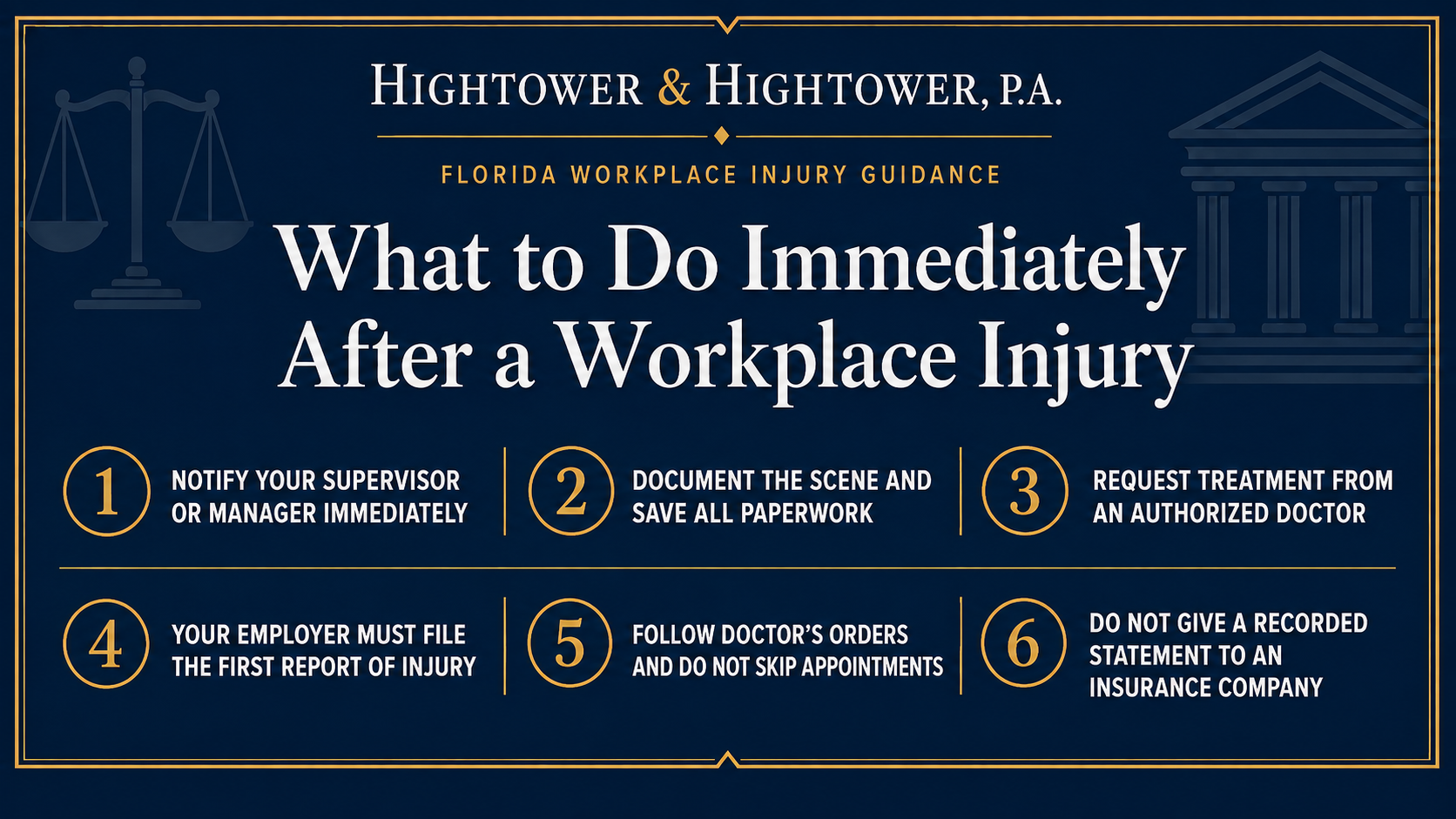
Steps to Take After a Workplace Injury
- Notify Your Supervisor or Manager Immediately
Report the injury the moment it happens, even if it seems minor at first. Verbal notice is a good starting point, but it’s best to follow up in writing (an email or text works) so there’s a timestamped record of when and how you reported it.
- Document The Scene and Save All Paperwork Related
If you’re able, take photos of where the injury happened, any equipment involved, and visible injuries. Get the names of coworkers who witnessed the accident. Hold onto every piece of paperwork tied to the claim, including incident reports, correspondence with others such as HR, and anything that the insurance adjuster sends you.
- Request Treatment From an Authorized Doctor
In the state of Florida, your employer or their insurance carrier has the right to select the treating physician. Ask your employer or HR representative who the authorized provider is before you seek care, since treatment from an unauthorized doctor may not be covered.
- Your Employer Must File the First Report of Injury
Once you’ve reported your injury, your employer is required to notify their insurance carrier, who then files a First Report of Injury or Illness with the state. If your employer is dragging their feet on this step, that’s a red flag worth raising with an attorney.
- Follow Doctor’s Orders and Do Not Skip Appointments
Missed appointments or ignored treatment plans give the insurance company a reason to argue that your injury isn’t as serious as you say, or that you’re not cooperating with your recovery. Attend every doctor’s appointment and follow through on prescribed treatment, physical therapy, and work restrictions.
- Do Not Give a Recorded Statement To an Insurance Company
Adjusters may ask to record a statement early in the process. You’re generally not required to agree to this, and anything you say can be used to minimize or deny your claim later. Speak with an attorney before providing any type of recorded statement.
“Hightower & Hightower provided outstanding support after my workplace injury. They were responsive, compassionate, and truly went above and beyond to achieve the best possible outcome for me.” — Terry F.
How Workers’ Compensation Is Calculated
In Florida, the amount of wage replacement benefits you’re eligible for is determined by your Average Weekly Wage, or AWW for short. To calculate this, we typically look at how much you earned, before taxes, over the 13 weeks leading up to your injury. Then, most disability benefits are usually paid out at about two-thirds of your AWW, but there’s a cap (or a maximum weekly amount) that’s set by the state each year.
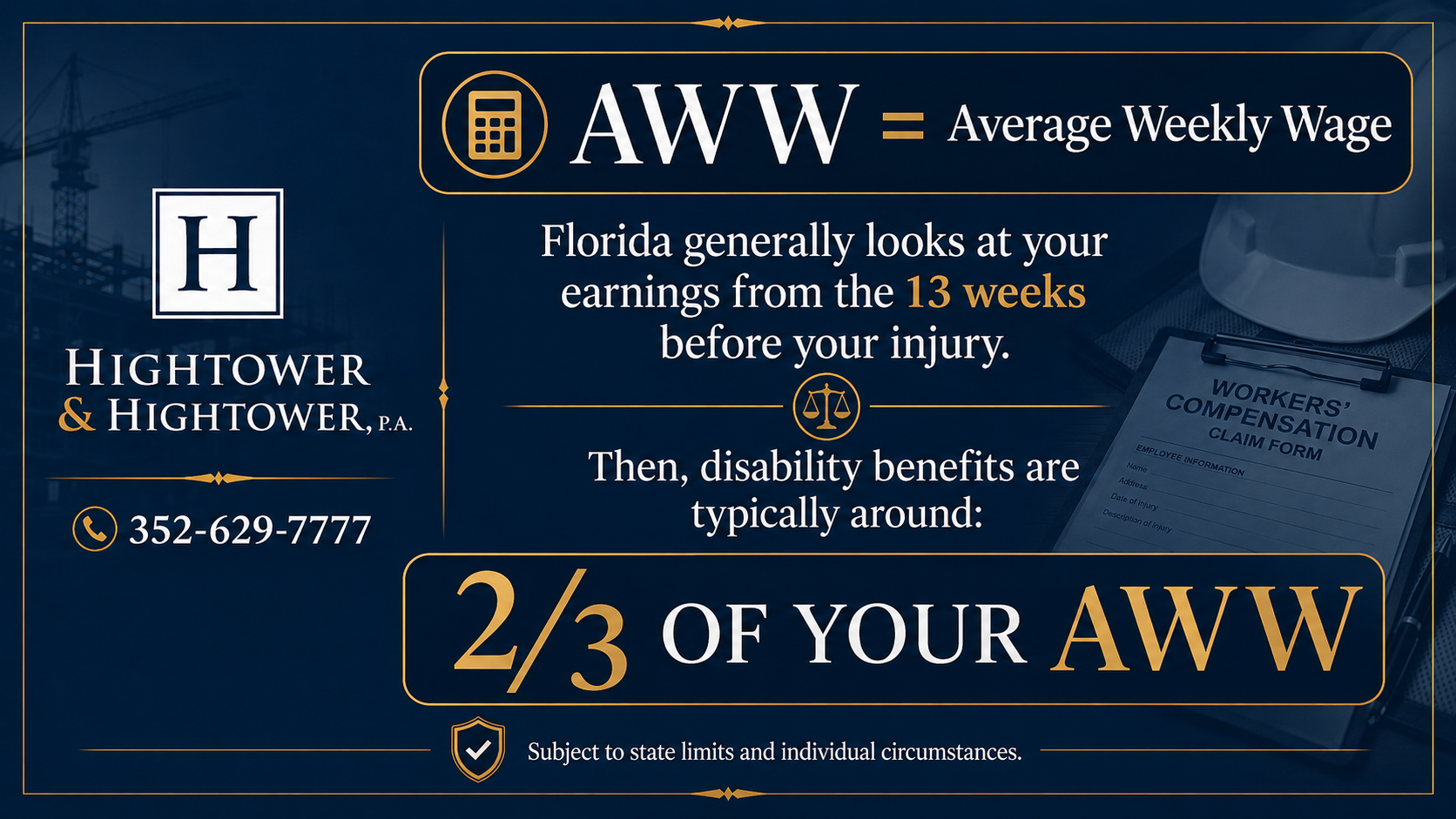
A few things that can affect this calculation:
- Overtime, bonuses, and the value of certain outside benefits may factor into your AWW.
- If you worked fewer than 13 weeks for your employer, other methods (like wages of a similar employee) may be used instead.
- Benefits are subject to a state-mandated minimum and maximum compensation rate, which changes annually.
Because AWW calculations can get complicated, especially for workers with variable schedules, tips, or multiple jobs, it’s worth having a workers’ compensation attorney double-check the math before accepting a benefit amount from the insurance company.

What Are the Eligibility Requirements for Workers’ Comp?
To qualify for workers’ compensation benefits in Florida, a few conditions generally need to be met:
- You must be classified as an employee, not an independent contractor (though some contractors in certain industries may still be covered).
- Your employer must have a workers compensation policy in place. In Florida, most employers with 4 or more employees are required to have it.
- The injury or illness must have occurred while the employee was performing job duties, and the injury must have arisen “out of and in the course of” employment.
- The injury must be reported within the required timeframe.
Certain situations can complicate eligibility, such as injuries that happen during a lunch break, off the premises, or while commuting to and from work. As each situation is different, it would be wise to contact an attorney who can evaluate your specific circumstances to determine if you have coverage under the workers compensation laws.
Rights of an Injured Employee Under Workers’ Comp
Florida law gives injured workers several protections, including the right to:
- Receive medical treatment for a work-related injury or illness
- Receive wage replacement benefits if the injury keeps you out of work
- Return to work once cleared by an authorized physician
- Appeal a denied or disputed claim
- Be free from retaliation, such as termination, for filing a legitimate claim
- Request a one-time change of physician if you’re unhappy with your authorized doctor
How To File a Workers’ Compensation Claim
- Report the injury to your employer as soon as possible.
- Your employer notifies their insurance carrier and completes the First Report of Injury.
- The insurance carrier assigns an authorized doctor for your treatment.
- You receive benefits (medical coverage and, if applicable, wage replacement) while you recover.
- If your claim is denied or benefits are cut off, you (or your attorney) can file a Petition for Benefits with Florida’s Office of the Judge of Compensation Claims to dispute the decision.
What a Workers’ Compensation Attorney Will Do For You
- Review your claim and identify any missing documentation or deadlines
- Communicate with the insurance adjuster on your behalf
- Push back on denied or delayed treatment requests
- Calculate whether your benefit payments reflect your true average weekly wage
- Represent you at hearings before the Judge of Compensation Claims if your case is disputed
- Negotiate a fair settlement if and when that becomes the right option
Do You Work in the State of Florida?
If you get hurt on the job in Florida, you have to tell your employer about it within 30 days (F.S. § 440.185). Otherwise, you risk losing your right to workers’ compensation benefits.
Frequently Asked Questions
What is the first thing I should do after a workplace injury?
It is in your best interest to report the injury to your supervisor or employer as soon as possible. Notify your supervisor or employer of the injury right away, even if it seems minor, and seek medical attention if needed.
What injuries need to be reported at work?
Any injury or illness connected to your job duties should be reported, whether it’s a sudden accident like a fall, or a condition that develops over time, like a repetitive strain injury.
Can I lose my job because of an injury?
Florida law prohibits employers from retaliating against workers for filing a legitimate workers’ comp claim. That said, workers’ comp doesn’t guarantee job protection the way certain federal leave laws do, so it’s worth talking to an attorney if you’re concerned about your job status while you recover.
What should I avoid saying in an injury claim?
Don’t minimize the severity of your injuries. Don’t provide information that you are not 100% sure is accurate. Don’t give recorded statements without speaking with a workers’ comp attorney first. Stick to the facts and let your medical records speak to the extent of your injury.
How long can you be on workers’ compensation?
It depends on your injury and recovery. Benefits will generally continue until you reach maximum medical improvement or return to work, though some injuries qualify for longer-term or lifetime benefits depending on severity.

Florida Workers’ Compensation Lawyers
Injured on the Job? Let’s Talk About Your Options. Workers’ compensation claims come with deadlines, paperwork, and insurance adjusters who don’t always have your best interest in mind. We do, and you don’t have to navigate this alone.
Hightower & Hightower, P.A. offers free consultations for injured workers, and you pay nothing unless we recover benefits on your behalf. We’ve also been fighting for accident victims for nearly 50 years. Let us fight for you.
Call Hightower & Hightower today or fill out our online form
to schedule your free, no-obligation case consultation.
This article is for general informational purposes and does not constitute legal advice. Every case is different. Contact our office for advice specific to your situation.





When To Call a Workers’ Compensation Lawyer
You will want to call a workers’ comp lawyer if: